We’re proud to share that Microsoft has been named a Leader in the 2026 Gartner® Magic Quadrant™ for Global Industrial AIoT Platforms. We believe this recognition reflects our vision for the future of industrial operations: moving toward intelligent systems that continuously learn, adapt, and improve business outcomes. Read the full 2026 Gartner® Magic Quadrant™ for Global Industrial AIoT Platforms report As industrial organizations modernize, they need a foundation that connects operations across cloud and edge environments.
Azure’s adaptive cloud approach, powered by Microsoft Azure IoT , Microsoft Azure Arc , Azure Local , Microsoft Fabric , and Microsoft Foundry , enables organizations to connect operational assets, contextualize data, apply AI-powered reasoning, and close the loop between insight and action. The shift towards learning operations The first wave of industrial digital transformation was driven by IoT, connecting operational assets and making industrial data accessible, at scale.
That visibility remains the foundation, but on its own it is not enough. Industrial organizations are contending with skilled labor shortages, supply chain volatility, increasing customization demands, and growing operational complexity. Success now depends on turning operational knowledge into scalable intelligence that improves throughput, quality, resilience, safety, and sustainability.
This is where Industrial AI and Physical AI create new value. Industrial AI applies intelligence to operational data, identifying patterns, predicting outcomes, diagnosing conditions, and recommending actions. Physical AI extends these capabilities into the real world , enabling autonomous or human-assisted action that learns from results and improves performance over time.
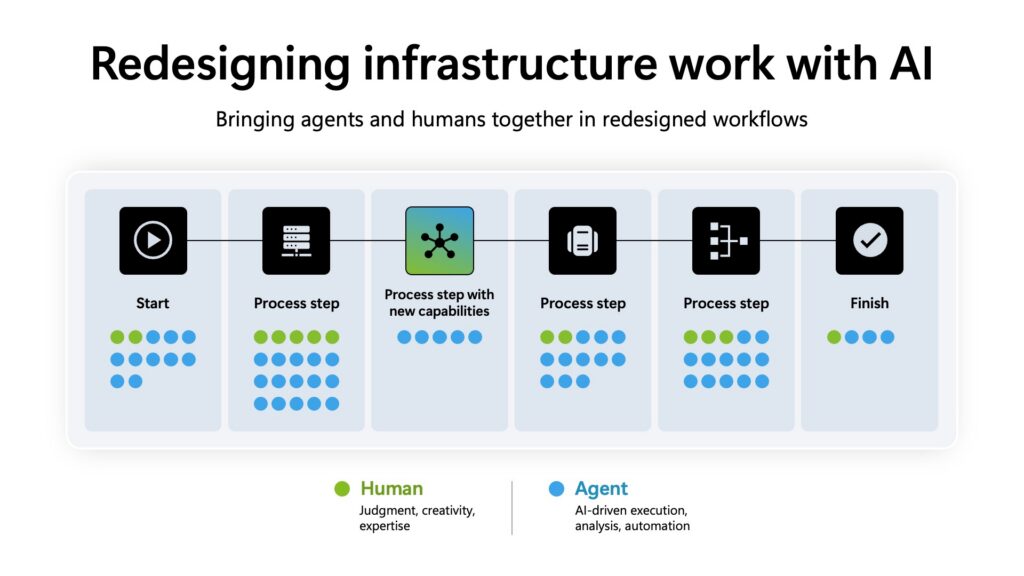
Together with IoT, they establish a business learning loop: IoT helps organizations understand operations. The people learn. Industrial AI helps organizations reason over operational data, identifying patterns, predicting outcomes, and recommending actions.
The systems learn. Physical AI helps organizations act, whether through autonomous operation or human-in-the-loop workflows. By measuring outcomes and feeding results back into future decisions, the process learns.
The outcome is more than automation. It is a transition from connected operations to learning operations, where every cycle of understanding, reasoning, action, measurement, and learning improves the next outcome. As the loop compounds over time, productivity increases, resilience improves, expertise scales, and the business itself becomes smarter.
Grounding the loop in organizational intelligence A learning loop must be grounded in the operational context unique to each organization. By applying AI through secure, governed platforms , organizations can capture and scale the knowledge embedded in their people, processes, assets, and operations, while maintaining control of the expertise and intellectual property that differentiate their business.
As that knowledge becomes institutional intelligence, it can be applied across adaptive workflows that continuously improve from real-world outcomes, helping organizations turn operational data into a durable source of competitive advantage. To accelerate this journey, the recently announced Microsoft Frontier Company initiative brings together industry expertise and enterprise-grade AI engineering to help customers design, deploy, and scale AI systems grounded in their own organizational intelligence, so they can translate operational expertise into measurable business impact more rapidly.
Recognized as a leader in industrial AIoT Gartner defines the global industrial AIoT platforms market as a series of seamlessly integrated technologies that deliver industrial data aggregation and curation, device management of industrial assets, ease of integration with IT systems, and the ability to unlock the value of industrial applications and AI. We continue to help industrial organizations transform by focusing on the areas our customers prioritize: Unified platform for industrial needs Microsoft’s industrial AIoT platform extends Azure from cloud to edge, providing a consistent foundation for managing and securing industrial environments while connecting data and AI across operations.
Key capabilities include Microsoft Azure IoT Hub , Azure IoT Operations , Microsoft Fabric , and Microsoft Foundry . Together, these capabilities help organizations make data-driven decisions, boost operational efficiency, and scale AI across varied deployment environments. Comprehensive management and security Microsoft offers a unified management and security plane where millions of distributed devices and assets, from factory Programmable Logic Controllers (PLCs) to autonomous vehicles, can be managed as first-class Azure resources.
Devices and assets connected through Azure IoT Hub and Azure IoT Operations are onboarded as Azure Resource Manager resources, enabling deep integration with Azure Device Registry and Azure’s control-plane AI capabilities for governance, insights, and automation. Microsoft is advancing a Zero Trust security roadmap across the device lifecycle, from trusted identity, certificate management, secure updates, and firmware risk monitoring to policy-driven deployments and integrated SecOps.
Encryption, confidential computing, sovereign operations, and auditable patching help customers strengthen resilience and meet evolving regulatory requirements. Governed industrial data foundation Microsoft provides a unified data plane delivered through Azure IoT Hub , Azure IoT Operations , Azure Device Registry , and Microsoft Fabric . The platform ingests OT, IoT, and enterprise data; transforms raw telemetry into structured, semantically aligned signals; supports Unified Namespace and ontology patterns; and makes governed, reusable, AI-ready data available across many different analytics and agent systems.
Originally published at azure.microsoft.com